
A Developer’s Guide to Making Geothermal Work at Scale
If you are planning new low-rise communities, geothermal heating and cooling is becoming harder to ignore. Once viewed as a niche option for custom homes or showcase sustainability projects, it is now being tested at production scale—where cost, repeatability, buyer appeal, and construction sequencing all must work.
That shift became more visible in May 2025, when Mattamy Homes and Diverso Energy announced a joint venture to advance sustainable homebuilding across Canada. The partnership brings together Mattamy’s production-building experience and Diverso’s geothermal utility model, creating a pathway for low-carbon communities that still meet practical expectations around design, affordability, and homeowner comfort.
Roadmap for Scalable Geothermal Communities
At Mattamy’s Upper Joshua Creek community, each home has its own borehole beneath the footprint, connected to a ground source heat pump inside the basement. This lot-by-lot approach keeps the model simple while delivering low-carbon heating and cooling.
The business model is just as important as the technology. Rather than asking you or your buyers to absorb the full upfront cost of underground infrastructure, Diverso Energy designs, builds, owns, and operates the borefield, like a utility. Homeowners then pay a predictable monthly geothermal fee. For you, that structure can help turn geothermal from a custom add-on into a scalable community strategy.
Choosing the Right Project
Geothermal is not automatically the right fit for every site. It works best when your project has enough scale, the right product type, and enough lead time for design and construction teams to coordinate. Larger phases help spread fixed costs across more homes.
- Scale: The ideal project size for financial optimization is over 100 homes. Mobilizing drilling rigs, crews, and equipment carries a cost, so for construction efficiency drilling 40+ homes at a time is ideal.
- Product type: Townhomes, back-to-back towns, and stacked towns often benefit most because outdoor space is limited and mechanical equipment can crowd patios, balconies, and side yards.
- Buyer value: Removing outdoor air conditioning units, gas meters, and vents creates a quieter, cleaner exterior experience buyers can see and understand.
Start Early: Timing Is Everything
The best time to evaluate geothermal is well before sales launch—ideally about a year before construction starts. At this point, you, your architects, mechanical designers, land development team, construction leads, utilities, and Diverso Energy can get aligned before key decisions are locked in.
Early planning is especially important in all-electric communities. Removing gas from individual homes may be straightforward, but nearby schools, restaurants, retail, multi-residential buildings, or neighbouring developments may still need gas service. You will need to coordinate those decisions with utilities, municipalities, and other stakeholders.
You will also want to settle design details early. Mechanical spaces may need to accommodate a ground-source heat pump and a tanked electric water heater instead of a gas furnace and a tankless water heater. Boreholes should be positioned close to mechanical rooms, and your lot layouts, foundations, structural elements, and equipment selections should be reviewed before drawings are finalized.
How Installation Works
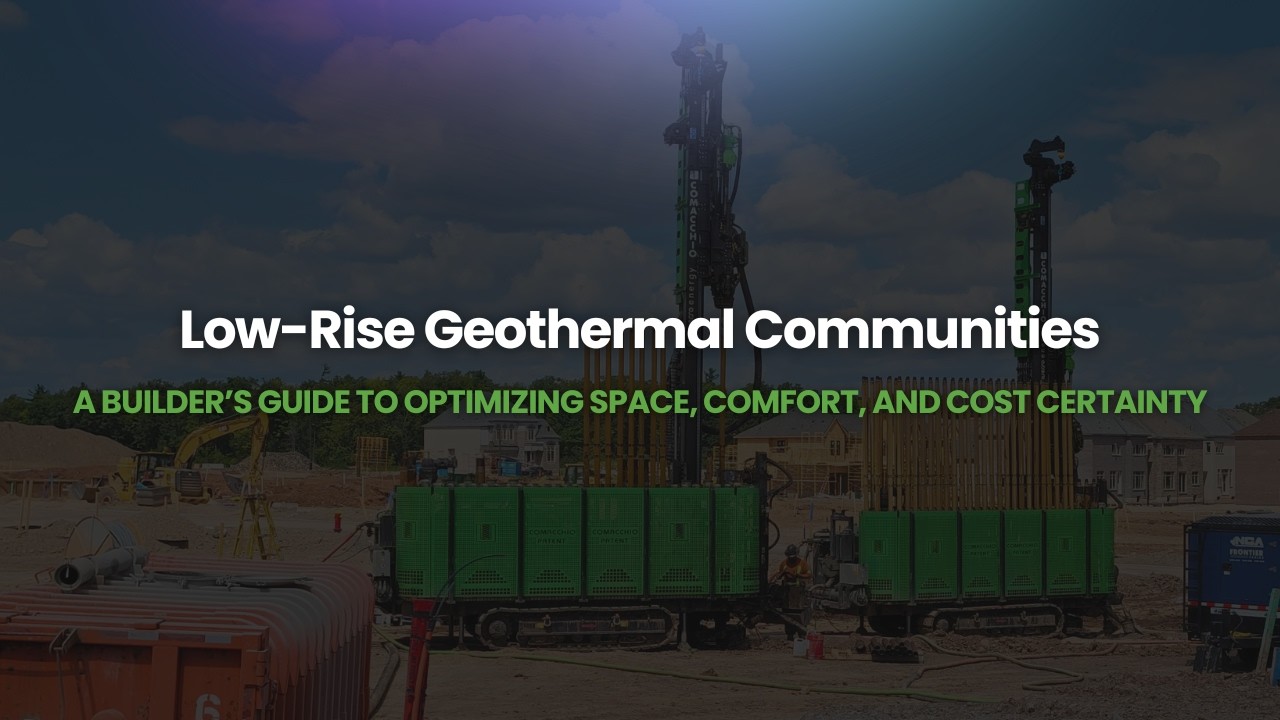
Installation starts before the home is built. Once roads and major services are in place, Diverso Energy drills a borehole within each home’s footprint. The location is coordinated with architectural and structural plans to avoid conflicts with foundations, footings, and other elements.
After drilling, construction looks familiar. Excavation follows, the borehole is protected or connected horizontally as needed, and the geothermal provider later flushes, fills, pressurizes, and tests the loop. The builder’s HVAC trades then connect the ductwork to the ground source heat pump.
A test hole is a small step that can prevent big problems. Geology drives drilling cost and schedule, and conditions such as pressurized aquifers or underground natural gas can complicate—or even disqualify—a site. Finding those risks early protects your budget and timeline.
What Changes Inside the Home?
For homeowners, a geothermal home should feel familiar. It still has a thermostat, ductwork, heating, and cooling. The difference is behind the scenes: instead of a gas furnace, air conditioner, and gas water heater, the home uses a ground source heat pump, an electric tanked water heater, and auxiliary electric heat for backup or temporary supplemental use.
That familiarity makes homeowner education essential. A gas furnace can recover quickly after a large thermostat setback; a heat pump performs best when it maintains a steady temperature. The message is simple: set it and leave it. That helps the system run efficiently and avoids unnecessary reliance on auxiliary electric heat.
Education should also cover hot water and electricity habits. A tanked electric water heater may require different expectations than a tankless gas system, and time-of-use rates can affect when homeowners run laundry, dishwashers, and other appliances.
The Homeowner Value Proposition
Sustainability matters, but most buyers are not choosing geothermal only because it is green. In an affordability-conscious market, your stronger story is lifestyle. Geothermal can make the home quieter, the outdoor space more usable, and the mechanical experience simpler.
- No outdoor condenser taking up patio or balcony space
- No gas meter or furnace venting on the exterior
- Cooling included as part of the system
- Quiet operation and fewer visible mechanical elements
- No on-site carbon monoxide risk from combustion equipment in the home
There may still be a modest monthly premium compared with a conventional gas furnace and air conditioner, depending on energy rates. However, the predictable geothermal utility fee can offset a significant amount of the cost over time, reducing exposure to volatile natural gas prices. As demand grows, standardization and volume may help reduce costs further.
Lessons for Developers
The biggest lesson is that geothermal is not just an equipment choice. It requires coordination. Your sales teams need to explain the homeowner experience, construction teams need to understand sequencing and borehole protection, and architects and mechanical designers need to plan equipment placement intentionally rather than leaving details to trades in the field.
The technology itself can be surprisingly simple: one borehole, high-density polyethylene pipe, a circulating loop, and a ground source heat pump. The innovation is in making that system repeatable through standardization, drilling efficiency, financing, utility ownership, and disciplined project coordination.
Diverso’s drilling fleet, integrated design team, and utility model allow geothermal to fit more naturally within production timelines while continuing to bring monthly costs down.
A Market-Ready Path Forward
The opportunity is not simply to build greener homes. It is to build better homes: quieter, more comfortable, more efficient, and more livable.
Geothermal works best when you treat it as core infrastructure, not an optional upgrade. That means bringing partners to the table early, choosing product types where the homeowner value is obvious, coordinating with utilities and design teams before decisions are locked in, and preparing sales and construction teams to explain the experience with confidence. As affordability pressures, electrification targets, and buyer expectations converge, geothermal offers you a practical path to communities that are cleaner, quieter, more efficient, and easier to live in.
Takeaway checklist for developers considering geothermal
- Assess project fit early: Review community scale, product type, phasing, lot layout, and drilling access before sales and construction decisions are finalized.
- Confirm site feasibility: Complete test drilling and geotechnical review early to understand subsurface conditions, drilling costs, and potential risks.
- Engage the geothermal partner up front: Bring the provider into planning with architects, mechanical designers, land development teams, construction leads, and utility stakeholders.
- Plan for all-electric coordination: Determine how removing natural gas affects homes, commercial uses, schools, restaurants, neighbouring developments, and municipal servicing.
- Optimize home design: Coordinate mechanical layouts, borehole locations, water heating equipment, ductwork, electrical requirements, and foundation details before drawings are locked in.
- Think in efficient construction batches: Align drilling schedules with phases large enough to make mobilization, equipment use, and crew time efficient.
- Build the buyer value story: Emphasize comfort, quiet operation, more usable outdoor space, included cooling, no outdoor condenser, no gas meter, and no combustion equipment in the home.
- Prepare sales and construction teams: Train teams to explain how the system works, what changes for homeowners, and how geothermal affects sequencing on site.
- Educate homeowners after move-in: Provide practical guidance on thermostat use, electric water heating, time-of-use electricity rates, and routine system expectations.
- Treat geothermal as infrastructure: Evaluate financing, utility ownership, long-term operations, billing, maintenance, and customer support as part of the development model.